
Why in NEWS ?
The paper, ‘Modern Technologies for Sustainable Food and Nutrition Security’, appears in the latest issue of the peer-reviewed journal Current Science. It is authored by P.C. Kesavan and Prof. Swaminathan, senior functionaries of the M.S. Swaminathan Research Foundation (MSSRF). The article is a review of crop development in India and transgenic crops — particularly Bt cotton, the stalled Bt brinjal as well as DMH-11, a transgenic mustard hybrid. The latter two have been cleared by scientific regulators but not by the Centre.
Why GM crops are flawed ?
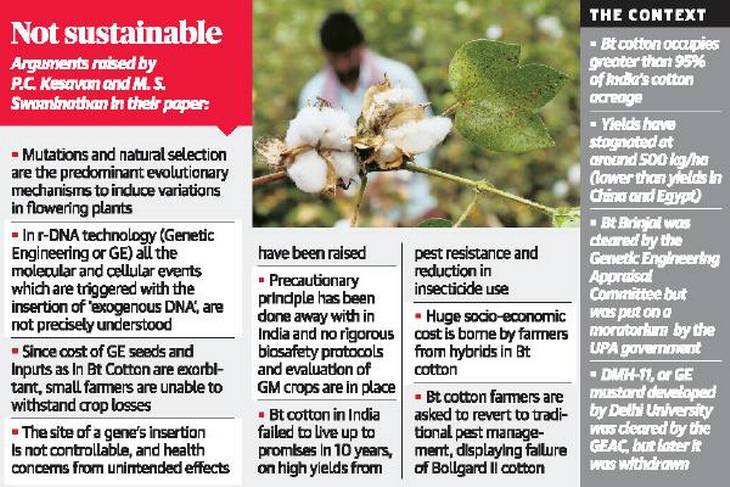
#1. Mutations and natural selection are predominant evolutionary mechanisms to induce variations and not GM technology.
#2. It has failed as a sustainable agriculture technology failing to provide livelihood security for cotton farmers who are mainly resource-poor, small and marginal farmers.
#3. The precautionary principle (PP) has been done away with and no science-based and rigorous biosafety protocols and evaluation of GM crops are in place.
#4. It raises questions on the genetic engineering technology as the cost of sowing is higher in GM Crops. This again burdens small farmers by high input cost.
#5. The insertion of foreign genes (in the plant) could lead to “molecular and cellular events that are not precisely understood.”
#6. Genetic modification is the technology of choice for solving abiotic problems like drought flood, salinity, etc. It may not be equally effective in the case of biotic stresses since new strains of pests and diseases arise all the time. This is why MSSRF [M.S. Swaminathan Research Foundation] chose mangrove for providing genes for tolerance to salinity.
GM crops are scientific
This research paper co-authored by leading agriculture scientist M.S. Swaminathan, which describes Bt cotton as a ‘failure,’ was criticised by India’s Principal Scientific Adviser (PSA), K. VijayRaghavan as ‘deeply flawed’.
#1. Major science academies of the world such as the U.S.’s National Academy of Sciences, the African Academy of Sciences and the Indian National Science Academy have supported GM technology.
#2. The U.S. National Academy of Sciences, after a massive consultation process, published a 420-page report in 2016 with the observation that “Bt in maize and cotton from 1996 to 2015 contributed to a reduction in the gap between actual yield and potential yield under circumstances in which targeted pests caused substantial damage to non-GE varieties and synthetic chemicals could not provide practical control”.
#3. Data from a billion animals fed on GM corn have not indicated any health hazards. Those in the Americas and elsewhere consuming Bt corn or soybean for over 15 years have not reported any health issues.
#4. The development of resistance can be tackled through practices like Integrated Pest Management and by stacking Bt genes to fight secondary pests.
Status of GM Crops of India
Bt cotton is not a failure in India. The yields hovering around 300 kg/ha at the time of introduction of Bt cotton (2002) have increased to an average of over 500 kg/ha, converting India from a cotton-importing country to the largest exporter of raw cotton.
GM mustard (DMH-11) is a technology to create mustard hybrids. Being a self-pollinator, mustard is difficult to hybridise through conventional methods. Genetic modification allows different parents to be combined easily, helping yields go up substantially. The herbicide glyphosate is only used for selection of hybrids and is not meant for farmer fields.
The moratorium on Bt brinjal is the most unfortunate step taken by the government in 2010 and has crippled the entire field of research and development with transgenic crops. Bangladesh has used India’s data to successfully cultivate Bt brinjal, despite all the negative propaganda. Reports indicate that as many as 6,000 Bangladeshi farmers cultivated Bt brinjal in 2017.
Source:
- M.S. Swaminathan calls GM crops a failure; Centre’s adviser faults paper
- Don’t believe the anti-GMO campaign
Recommended Articles about Plant Biotechnology


