
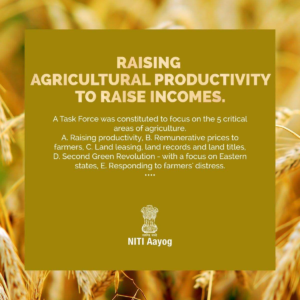
In view of the goal of the government to double farmer’s income by 2022, a series of initiatives have been taken by NITI to usher in critical reforms in the agriculture sector. Some major initiatives are:
(i) Model Act on Agricultural Land Leasing, 2017
To recognize the rights of the tenant and safeguard interest of landowners NITI Aayog formulated a Model Agricultural Land Leasing Act, 2016 that would enable investment, technology, economy and employment in agriculture. Several States like Uttar Pradesh, Uttarakhand, Madhya Pradesh, Odisha, Karnataka, Telangana and Andhra Pradesh have either already adopted or have initiated work to amend their respective laws.
(ii) Reforms of the Agricultural Produce Marketing Committee Act
NITI Aayog in consultation with the Ministry of Agriculture, States and other stakeholders launched in February, 2017 the Model Agricultural Produce and Livestock Marketing Committee (APLMC) Act 2017. States are being asked to adopt the APMC Act.

(iii) Agricultural Marketing and Farmer Friendly Reforms Index:
NITI Aayog developed the first ever ‘Agriculture Marketing and Farmer Friendly Reforms Index’ to sensitise States about the need to undertake reforms in three key areas of agriculture market, land lease and forestry on private land (felling and transit of trees). The aim of the index is to induce healthy competition between States.
(vi) Pradhan Mantri Krishi Sinchayee Yojana:
A roadmap for Pradhan Mantri Krishi Sinchayee Yojana was prepared and shared with the concerned Central Ministries/Departments, the States and other stakeholders.
(v) Price Deficiency Payments
Concept of price deficiency payments as an alternative to physical procurement of agricultural produce by the government under Minimum Support Price (MSP) has been proposed by NITI. Pilots are being proposed in Maharashtra and Madhya Pradesh for cotton and pulses, respectively.
(vi) Rejuvenating Fertilizer Sector
To achieve the aim of India becoming self-sufficient in the production of urea by 2022, NITI steered several committees for revival of new plants at Gorakhpur, Sindri, Barauni and Ramagundam, and selection of technology for Talcher plant. Pilot project of introduction of Direct Benefit Transfer (DBT) in fertilizer was successfully completed in several States and taken forward for implementation across all States.
(vii) Alternative Mechanisms for Implementation of Minimum Support Price (MSP)
Consequent to the announcement made under the Budget 2018-19, NITI Aayog has been tasked with developing alternative mechanisms for implementation of MSP for different agricultural crops. NITI Aayog, in consultation with the Central Ministries, States and other stakeholders, has laid down a mechanism comprising three options: Market Assurance Scheme, Price Deficiency Payment Scheme, and Private Procurement and Stockist Scheme.
(viii) TASK FORCE ON PILOTING BUSINESS MODEL FOR DOUBLING FARMERS’ INCOME
NITI Aayog has constituted a task force to develop a business model that will focus on the implementation of the pilot projects to demonstrate the doubling of farmer’s income. The initiative will promote 10 pilot projects in different agro-climatic regions of India, preferably through social entrepreneurs. The key principlesdriving the initiative are market driven approach, encouraging application of science and technology in agriculture production, minimizing farmer’s risks and using of modern business practices for value addition in agriculture sector.
Source : PIB year end review. Republished for education purpose.
In Detail | Also Read : Role of NITI Aayog in Agriculture


