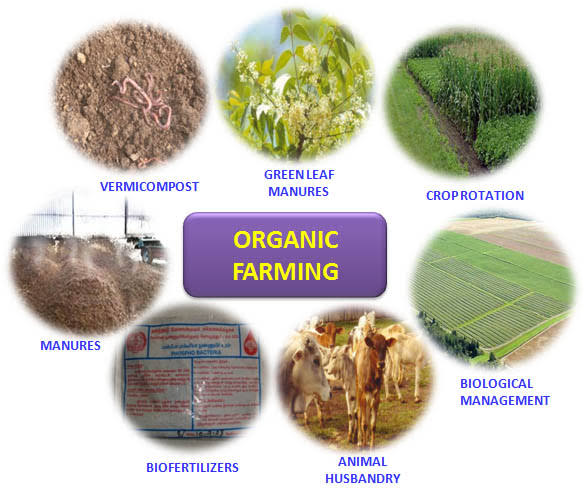
Organic farming is defined as a production system which largely excludes or avoids the use of fertilizers, pesticides, growth regulators, etc. and relies mainly on organic sources to maintain soil health, supply plant nutrients and minimize insects, weeds and other pests. It was felt that organic farming may solve all these problems and has been considered as one of the best options for protecting/sustaining soil health, and is gaining lot of importance in present day agriculture.
Organic farming is based on production standards which are environmentally supportive and are socially, economically and ecologically sustainable. It is believed to play a pertinent role in safeguarding biodiversity, improving the soil health, and inclusive & sustainable development of the farming community.
Present status of organic farming in India
India holds a unique position among 172 countries practicing organic agriculture: it has 6,50,000 organic producers, 699 processors, 699 exporters and 7,20,000 hectares under cultivation. But, with merely 0.4 percent of total agricultural land under organic cultivation, the industry has a long journey ahead.
Organic agriculture, has always been India’s inherent advantage and strength. The shift in the global consumption patterns, health awareness among the consumers and the increasing significance of sustainability is now putting organic products to the forefront both internationally as well as in the domestic market.
India produced around 1.35 million MT (2015-16) of certified organic products which includes all varieties of food products. The production is not limited to the edible sector but also produces organic cotton fiber, functional food products etc. as per the latest available cross-country statistics, in the year 2015, India ranked first in terms of the number of organic producers among over 170 countries and ninth in terms of the area under organic agriculture. India ranked 11th in organic product exports in 2015.
India is home to 30 per cent of total organic producers in the world, but accounts for just 2.59 per cent (1.5 million hectares) of the total organic cultivation area of 57.8 million hectares. However, it has been observed that when it comes to the area under certified organic cultivation, India contributes only 2.59%, i.e., 1.5 million hectares of the total organic cultivation area of 57.8 hectares. Thus, amongst the regions with the largest areas of organically managed agricultural land, India ranked 9th.

Lack of proper knowledge transfer has been a limiting factor towards large scale organic conversion or reduction in chemical load under conventional farming practice. Besides this, majority of agro-research does not prioritize/focus on dissemination of research outcome at farmer’s level. There are limitations like availability of practical guidelines, communication gap with small and marginal farmers and lack of comprehensive approach for integration of technological know-how, better marketing options etc. which led to lesser farmer’s participation in large scale demonstration.
Opportunities in organic farming
According the IFOAM (2009) organic agriculture has a significant role in addressing two of the world’s biggest and most urgent issues- (1) climate change (2) hygienic food security.
Organic farming practices are ecologically sustainable in terms of (1) soil fertility stability (2) increased diversity of microbes, plants and animals (3) increased carbon sequestration and (4) reduced energy dependence.
1. Stability of Soil Fertility
In conventional agriculture, soil fertility declines with crop harvest. For this reason, global fertilizer use increased from 27.4 million tons (1959-60) to 143 million tons (1989-90) and likely to reach to 208.0 million tons by the year 2020. Use of organic supplements is an effective way to reverse this trend.
Organic supplements are easily colonized by microorganisms that help to stabilize soil fertility via improving decomposition, nitrogen fixation and reducing the losses of nutrients. Additionally, green manures help in mobilizing nutrients, enhancing growth promoting substances, suppress soil-borne pathogens and support crops to out-compete weed and present soil erosion.
2. Biodiversity Conservation
As organic farm practices are largely intrinsic and enhance food resources, habitat heterogeneity (management of field margins and non-crop habitats), prey-predation relationships, and reduce toxic influences (prohibited use of chemical pesticides/inorganic fertilizers), these are expected to support species vulnerable to otherwise conventional farm practices.
3. Carbon sequestration
Compared to the carbon stored in a forest, the Social Organic Carbon in agricultural soils can effectively benefit food production and improve agricultural sustainability. An increase of 1 ton of soil Carbon pool of degraded cropland may increase crop yield by about 10 to 20 kg/ha of maize, 20 to 40kg/ha of wheat, and 0.5 to 1 kg/ha of cowpeas indicating a strong link between C-sequestration and crop production.
4. Reduced Energy dependence
Fossil fuel energy inputs is required in farm machinery, transport, production of synthetic fertilizer and pesticides, etc. synthetic fertilizers used in conventional systems, are produced employing fossil fuel energy whereas cattle manure, legumes, etc., with very low energy needs, are used in organic practices.
B. Economic sustainability
The conventional mode of agriculture, which works on the principle of diminishing return, may cause long-term economic risks influencing the overall balance of trade compared to its sustainable counterpart.

Challenges of Organic Farming
1. Resources need
Livestock resources play important role in strengthening agricultural practices for large masses in India. With the advent of technology, the livestock population in our country has declined sharply. Further, a large part of the rural population in our country is poor and depends on animal manure for domestic fuel. This further constrains the availability of animal manure for agricultural use.
Lack of sufficient stock of vermicompost and biofertilizers in the local market further constrain associated with the availability of appropriate amount of biopesticides may also lead organic producers in India to risk.
Additionally, most of the crop residues in our country are removed from the fields for the purpose of fodder and fuel. This has led the use of mulch farming technique towards failure.
2. Certification
Time lag of three-years (conservation stage), often constrain small landholders from adopting organic farming. The certification is essential to authenticate organic produce and to validate the price margin the market. The Director General of Foreign Trade (India) permits the export of organic produce if these are produced and processed under a valid certification. Lack of knowledge and access to certification discourage the small farm holders in India.
To overcome these issues, training and institutional demonstration with fiscal incentives is being provided to encourage small farm holders.
3. Social acceptance
The majority of small farm holders depend on government incentives and are striving for a profit margin in the indigenous market. Therefore, small farm holders in our country are apprehensive towards adopting organic farming.
Major issues that need to be resolved to encourage acceptance in small farm holdings include access to certification, lack of local market, cost-benefit anomalies, lack of appropriate knowledge to Organic inputs and non –availability of organic supplements.
Strategies to promote Organic Farming in India
1. Promoting Organic Farming through Agro Tourism: By which urban families are encouraged towards organic farming and farmers also gets premium prices.
2. Getting support of professionals in branding organic products.
3. Retailing, Packaging and Labelling should also be better managed to promote organic products. Like attractive package through organic waste.
4. High value crops having commercial viability, industrial use and export potential should be considered over other crops.
With a large geographical area and diversity of eco-region, our country has a considerable potential to capitalize on organic farming. However, small farm holders in India are constrained by issues such as resource availability, certification, lack of local market and other factors. Therefore an integrated effort is needed by the government and non-government organizations to remove constraints encouraging small farm holders to adopt organic farming as a solution to meet food demand while conserving the soil, water, energy and biological resources.
