
Bamboo is part of rural livelihood in many countries, especially in developing counties like India. Due to its versatile nature and multiple uses, it is also called ‘poor man’s timber’. Though it grows tall like a tree, it belongs to the grass family. It can withstand drought as well as flood.
India is second only to China in terms of bamboo diversity. The North-Eastern States are a storehouse of bamboo diversity, home to 58 bamboo varieties.
Bamboo is grown on 10 million hectares in India and covers almost 13 per cent of the total forest area. The total production of bamboo is five million tonnes per year. About 8.6 million people depend on bamboo for their livelihood. The value of bamboo in India is estimated at $4.4 billion.
Restructured National Bamboo Mission (NBM)
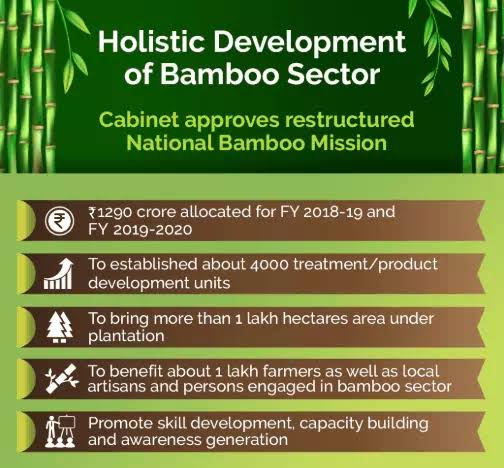
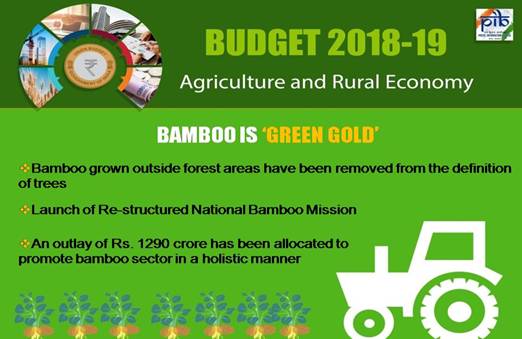
The restructured National Bamboo Mission (NBM) has been launched in April, 2018 with an outlay of Rs.1290 crore for two year i.e. till the end of 14th Finance Commission. Budget Estimate for the Year 2018-19 is Rs.300.00 crores. The scheme aims to supplement farm income of farmers with focus on the development of complete value chain of bamboo sector to link growers with consumers.
Re-structured National Bamboo Mission, which is based on a cluster based approach to address the complete bamboo value chain and promote bamboo sector in a holistic manner. With a focus on linking bamboo growers with consumers; creation of facilities for collection, aggregation, processing, marketing, MSMEs, skill building and brand building, this announcement would contribute in generating additional income for farmers, employment opportunities for skilled and unskilled youth especially in rural areas.
Major objectives of the Mission are:
- To increase the area under bamboo plantation in non forest Government and private lands to supplement farm income and contribute towards resilience to climate change as well as availability of quality raw material requirement of industries.
- To improve post-harvest management through establishment of innovative primary processing units near the source of production, primary treatment and seasoning plants, preservation technologies and market infrastructure.
- To promote product development keeping in view market demand, by assisting R&D, entrepreneurship & business models at micro small and medium levels and feed bigger industry.
- To rejuvenate the under developed bamboo industry in India.
- To promote skill development capacity building, awareness generation for development of bamboo sector from production to market demand.
- To re-align efforts so as to reduce dependency on import of bamboo and bamboo products by way of improved productivity and suitability of domestic raw material for industry, so as to enhance income of the primary producers.
So far 88 Bamboo Treatment Units, 464 Product Development /Processing Units, 135 infrastructure Projects for Promotion and Development of Bamboo Markets have been approved in 16 States as per the Annual Action Plans received for 2018-19. The operational guidelines also provide for assistance for value added product development and processing, development of tools & equipments, research & development, both in the Government and Private Sector which could include start ups also.
Bamboo not a tree
The Indian Forest (Amendment) Bill, 2017 permits felling and transit of bamboo grown in non-forest areas. However, bamboo grown on forest lands would continue to be classified as tree and would be guided by the existing legal restrictions. This will now create a viable option for cultivation in 12.6 million hectares of cultivable waste land. It will encourage farmers and other individuals to take up plantation/block plantation of suitable bamboo species on degraded land, in addition to plantation on agricultural land and other private lands under the agro-forestry mission.
Other initiatives to promote Bamboo
Considering the need and demand from bamboo based stakeholders and to provide cheaper bamboo products to the consumers, the Government has reduced GST on bamboo furniture & bamboo flooring to 12%. The Mission also envisages establishment of primary processing units close to the production area to reduce transportation costs and complete utilization of bamboo to move towards zero wastage so as to improve economies and lower costs to consumers.
For popularizing use of bamboo & bamboo based products – seminars, conferences, awareness campaign etc. at National, State & Districts Levels, & capacity building programmes for participants including farmers/artisans & field functionaries have been approved so far under the restructured NBM. Awareness is also created through print and electronic media and participation of NBM in fairs and other events.
Thus Government should utilise bamboo as a renewable resource to rebuild green economy to achieve the goals of sustainable social and economic development, especially of the weaker sections of society who are engaged in bamboo resources.
With Inputs from Press Information Bureau, The Hindu Business Line


