
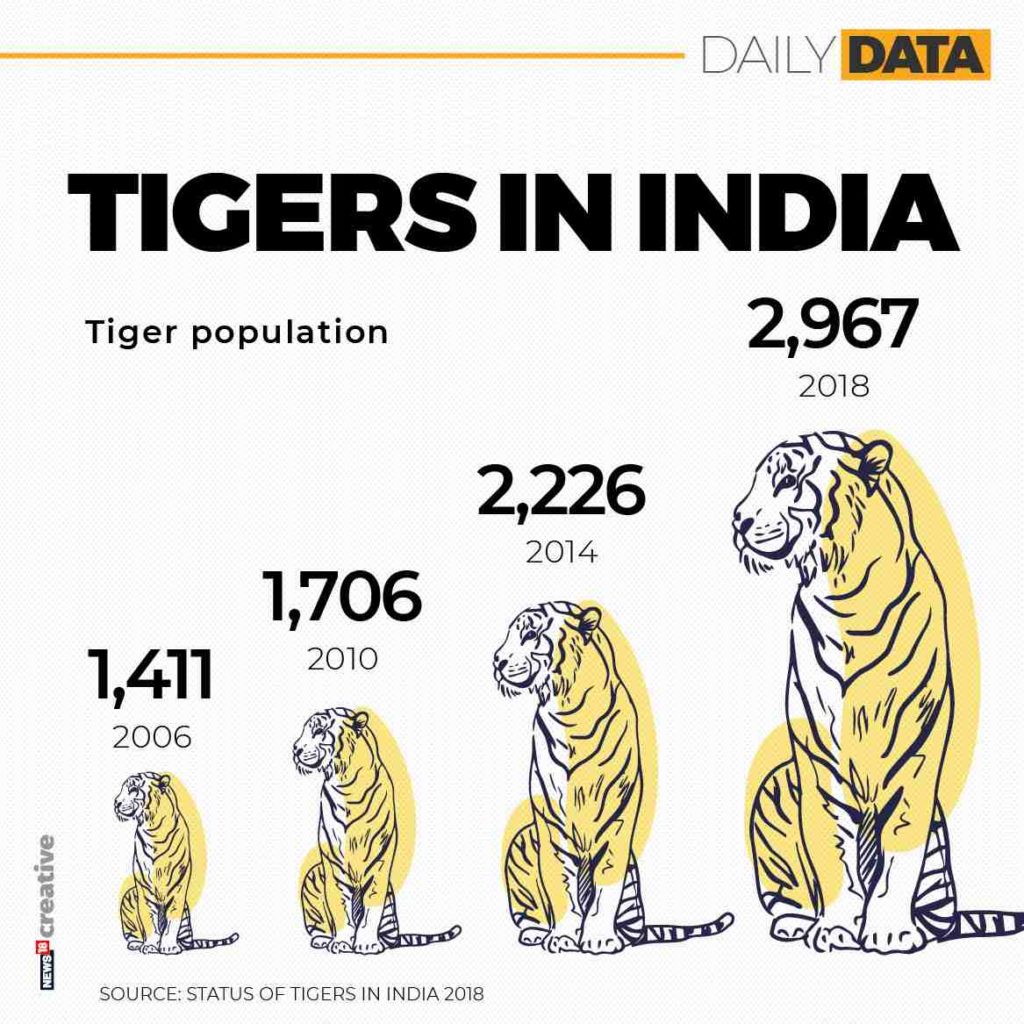
On the occasion of International Tiger Day on 28 June 2019, Prime Minister Narendra Modi released the results of the fourth cycle of All India Tiger Estimation – 2018, at New Delhi today. The count of tigers in India has risen to 2967, in 2018, according to this census.
Speaking on the occasion, the Prime Minister described this as a historic achievement for India, and reaffirmed India’s commitment towards protecting the tiger. The Prime Minister appreciated the speed and dedication with which various stakeholders worked to achieve this. The Prime Minister said that with almost 3000 tigers, India is today among the biggest and most secure habitats.
Snippets from the Status of Forest Report
- There has also been an increase in the “protected areas.” In 2014, there were 692 protected areas, which increased to more than 860 in 2019. The “Community Reserves” have also grown from 43, in 2014, to more than 100 now.
- The 33% rise in tiger numbers is the highest ever recorded between cycles which stood at 21% between 2006 to 2010 and 30% between 2010 and 2014.
- Madhya Pradesh saw the highest number of tigers at 526, closely followed by Karnataka at 524 with Uttarakhand at number 3 with 442 tigers.
- Chhattisgarh and Mizoram saw a decline in their tiger numbers while tiger’s numbers in Odisha remained constant. All other States witnessed a positive trend.
- Viewed at the landscape level, all 5 landscapes showed an increase with the Central Indian landscape recording the highest increment.
- Pench Tiger Reserve, Madhya Pradesh scoring the highest and Sathyamangalam Tiger Reserve, Tamil Nadu showing the highest increment in management.
- 42% of the tiger reserves fell in the Very Good management category, 34% in the Good category, 24% in the Fair category while no tiger reserve was rated Poor.
It was a moment of pride for the country as it achieved its commitment to the St.Petersburg Declaration, of doubling Tiger population, much in advance to the 2022 deadline.
It’s Digital Survey – Using App and AI
India has been estimating its tigers using a double sampling approach involving a mark-recapture framework to ascertain tiger numbers, which is being improved over time keeping in view advancements made in science.
During the 4th cycle, in sync with Government of India’s “Digital India” initiative, data was collected using an Android based application- M-STrIPES (Monitoring system for Tigers’ Intensive Protection and Ecological Status) and analyzed on the applications’ desktop module.
The, application greatly eased out analysis of a large quantum of data that was collected over nearly 15 months involving survey of 381,400 sq. km. of forested habitats. Besides cameras were placed in 26760 locations which gave a total of 35 million images of wildlife including 76523 images of tigers. Segregation of these images was possible in a short time because of use of artificial intelligence software.
Projecting tiger reserve as engines of growth was highlighted in the report released on Economic Valuation of Tiger Reserves which was jointly published by the NTCA and the Indian Institute of Forest Management Bhopal.
In conclusion, the Prime Minister called for even greater efforts, towards Tiger Conservation.
With inputs from PIB, Featured Image : Manoj Kumar


